
The global investment environment in 2026 is defined by heightened geopolitical risk, elevated uncertainty around energy markets, and a late-cycle economic expansion characterised by uneven growth and inflation elements. For Australian investors, these forces may underline the importance of diversification across regions, asset classes and currencies, while remaining mindful of currency volatility and geopolitical tail risks. Below we outline the current global backdrop and explore portfolio considerations.
The Current Global Investment Backdrop
Global growth remains resilient but fragile. The International Monetary Fund projects global GDP growth of approximately 3.3% in 2026, supported by technology investment and easing financial conditions, yet identifies geopolitical escalation as a primary downside risk. Similarly, the World Economic Forum’s Global Risks Report 2026 ranks geo-economic confrontation and regional conflict as the most significant near-term global threats.
Equity (share) markets, particularly in the United States, continue to be supported by earnings growth and investment in artificial intelligence, but valuations remain sensitive to shocks that could disrupt energy prices or inflation expectations. Bond markets are increasingly exposed to renewed inflation risks should commodity prices re-accelerate, which is likely. Australian equities are vulnerable to the shocks of fast-moving global news especially arising from surges in costs of supplies. Yet opportunities for exports, especially materials and energy resources, provide hope for increased trade outcomes.

Market Sentiment
The CNN Greed & Fear Index is currently registering at ‘16’ (see below) among American investors. Market/Economic/Business fear has been as low as 9 recently. This signals there is great uncertainty around. To provide some context, the index registered 19 one year ago when circumstances appeared nowhere near as uncertain as they may be today.
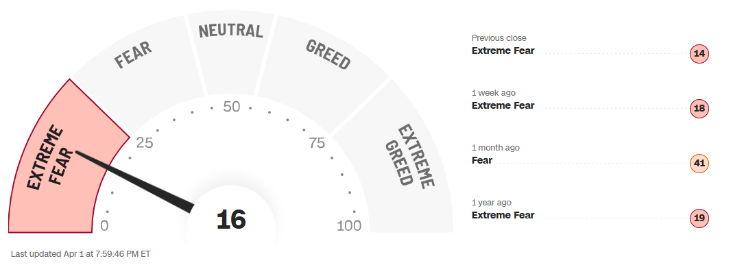
Using such indicators tends to overstate the emotions of participants with circumstances never resolving to be as bad or as good as these may represent.
Implications for a Diversified Portfolio
Diversification remains the most effective defense against geopolitical uncertainty across equities, fixed income, real assets (property/infrastructure) and currency exposure.
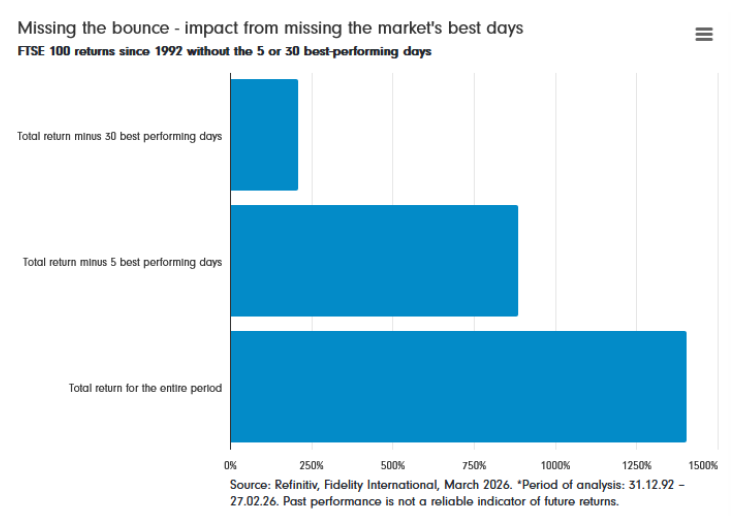
In virtually every developed market, staying the course of diversification consistently proves the most successful strategy. The three bars below show the total return from the FTSE 100 (UK share market) since 1992 if the best 30 days are taken out (the top bar), the best five days are taken out (the middle bar) and if you remain invested for the whole period (the bottom bar).
It is no surprise that returns fall if you don’t include the market’s best days, but the lesson here is that timing the market – trying to jump in and out to get a better return – adds risk to your investing. The chart represents a worst-case scenario – you would have to be seriously unlucky to miss just the best days and none of the worst – but you create the risk of that when you duck in and out of markets trying to find only the winning periods.
It is a reminder that the simplest route to capturing the potential gains offered by markets is to just stay invested.
Conclusion
Geopolitical uncertainty is structural, diversification is critical, and long-term discipline remains essential. Research repeatedly verifies that for most investors, remaining invested in quality assets is key to long-term portfolio outcomes.

This information is intended as a guide only and professional advice should be sought for individual circumstances.